Sign inCreate free account

Source-available · Free alpha · Bring your own AI

Requirements, traceability and V&V evidence, with AI agents that work inside the audit trail.

DOORS-grade rigour without the DOORS-grade licence: typed artifacts, stable references, baselines, verification runs, documents, and AI agents that propose changes for your team to approve. Source-available. Bring your own AI.

No card. No trial clock. Export your data whenever you like.

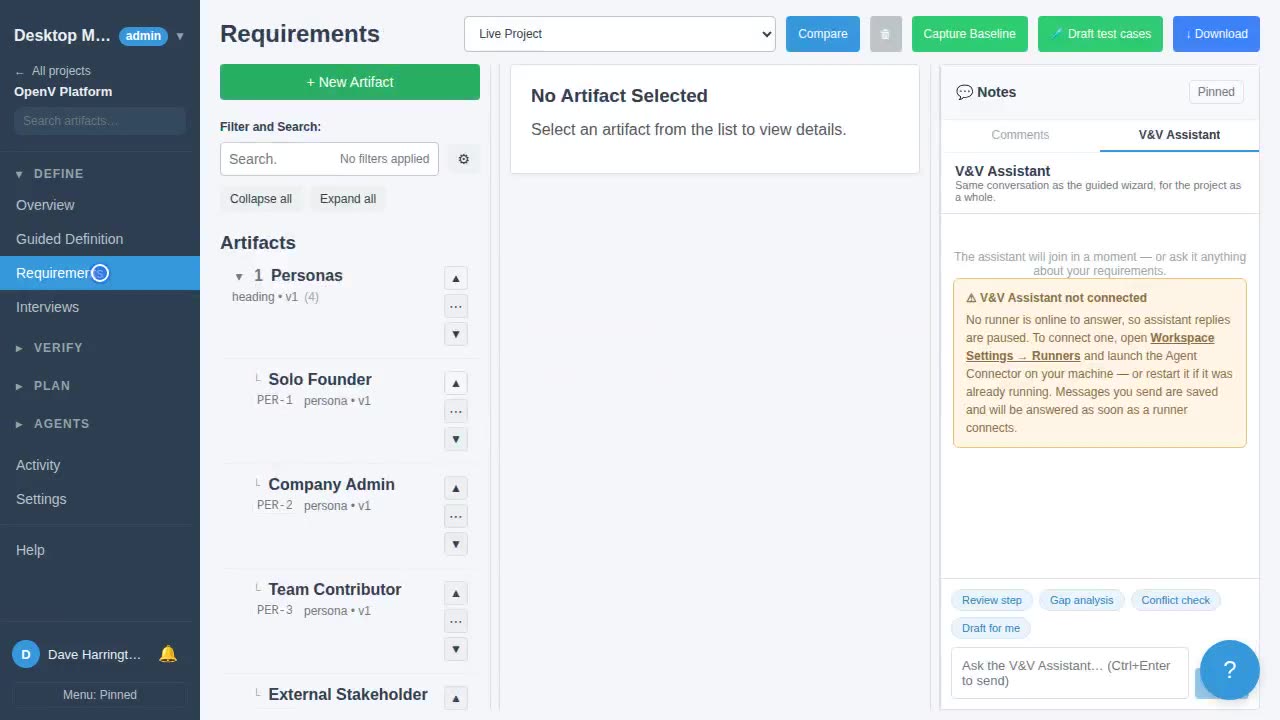
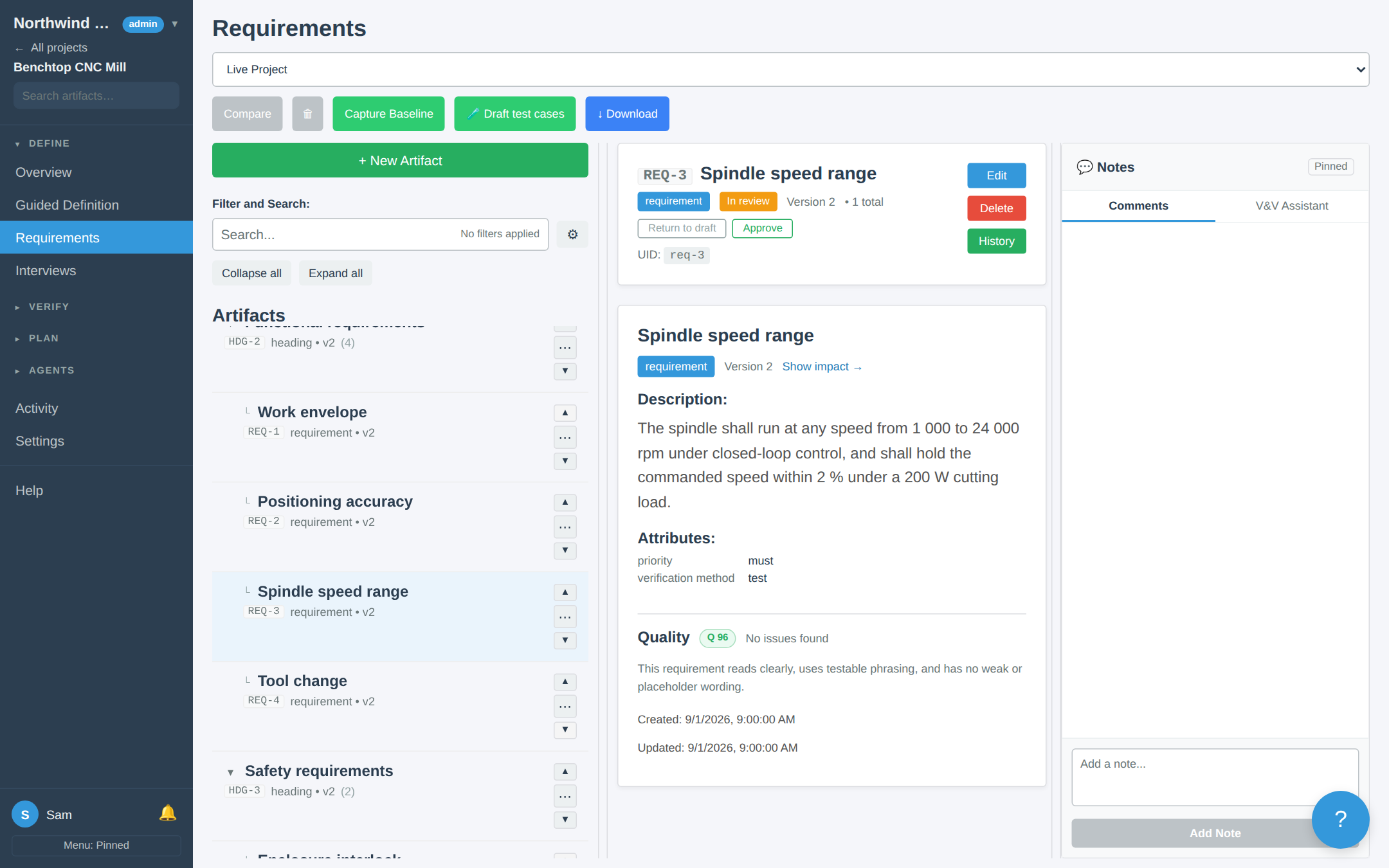
The OpenV requirements module: a tree of requirements with stable refs beside the selected requirement's document and traceability links
The requirements module: tree, document and traceability side by side.

See it working

Five narrated recordings on the platform’s own requirements project, three on a desktop and two on a phone. No slides, nothing staged.

What it does

One place for what your product must do, why, and the proof that it does. Every artifact has a stable ref, a history and typed links, so the answer to “what changed and what does it affect” is a click, not a meeting.

Requirements and traceability

Requirements, user needs, design items, hazards and test cases with stable refs, typed links, version history, suspect-link review and immutable baselines.

V&V evidence

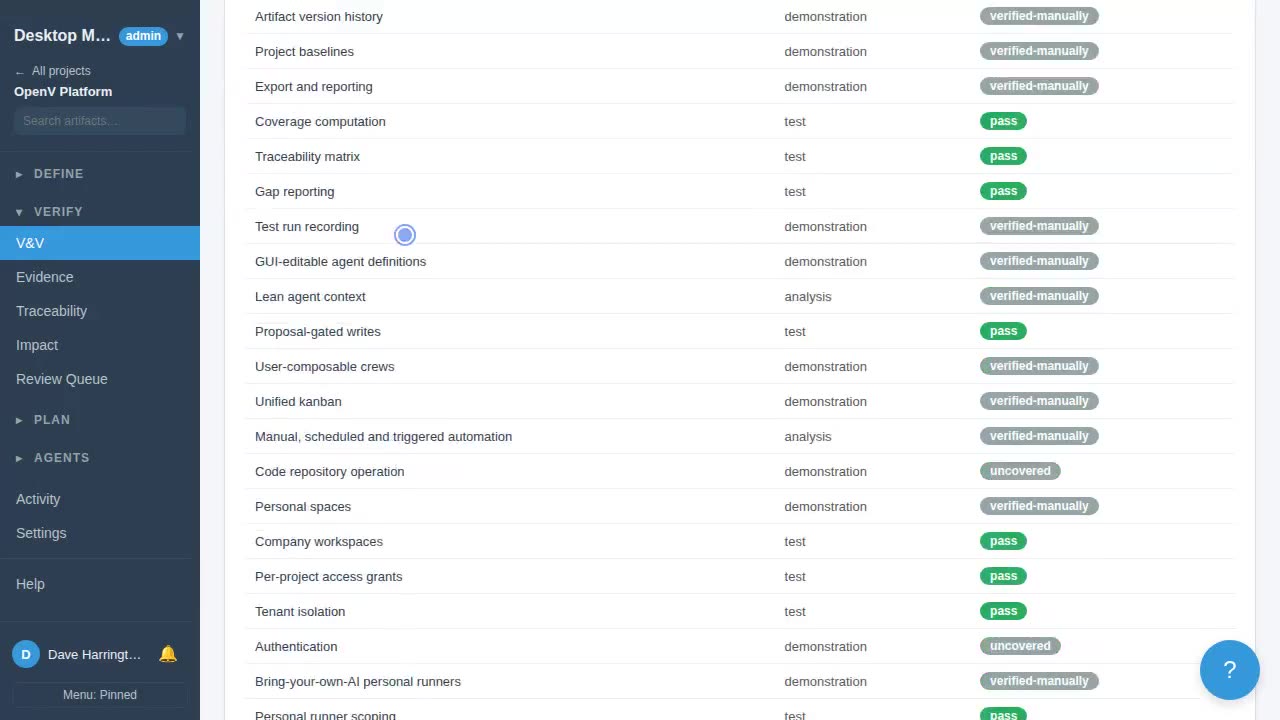
Test runs record results against test cases. Coverage, gaps and the traceability matrix update as links change, and the V&V status ships as a PDF.

Agents with human review

Agents read your project through typed tools and write back as proposals you approve. Kanban cards launch runs; automations run on a schedule or an event.

Stakeholder interviews

Share a link. An interviewer agent talks to the stakeholder and records candidate needs as draft artifacts for your team to review.

Documents and hand-over

PDF and Word specifications with the sections, fields and evidence you choose, from the live project or any baseline; ReqIF for the tool on the other side; a share link for anyone who only needs to read.

Programmes, not just projects

Subsystems and suppliers work in their own projects, refine the requirements above them, and verification rolls back up the tree. Owners and reference parties say who is responsible for what.

How it fits together

Needs, requirements, design and tests in one typed graph; agents that propose and people who approve; baselines, documents and share links to hand the result over. The diagrams are on one page.

Share a link
A public link opens the live project read only, no account needed; a reviewer link lets someone comment without editing.
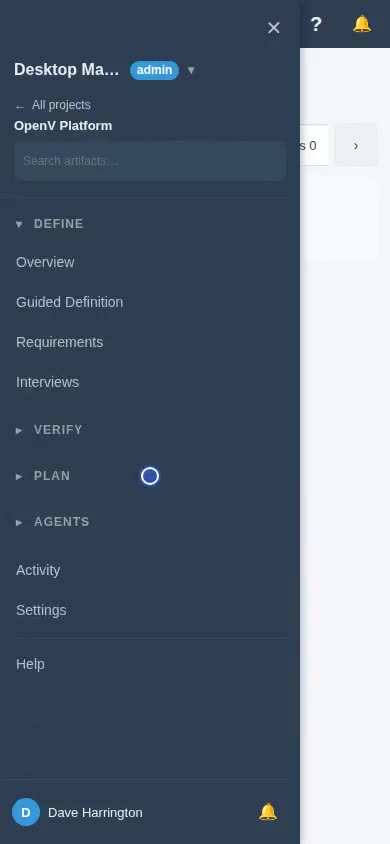
On a phone
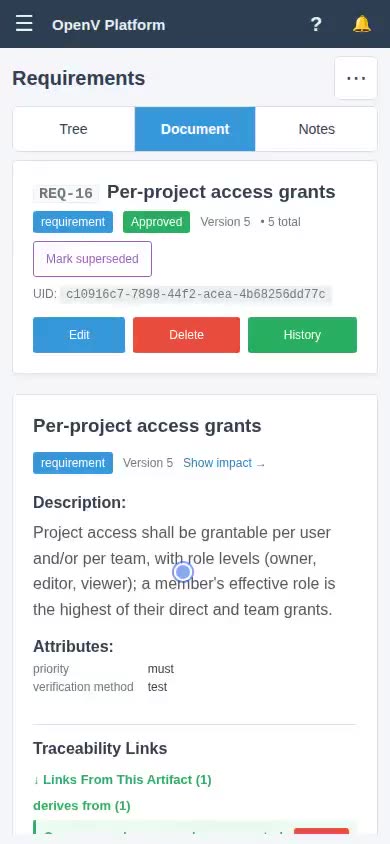
Review, approve and comment with a thumb; install it and get notifications as pushes.
Flow-down
Subsystems and suppliers work in their own projects, refining the requirements above them.
Documents
PDF and Word with the sections and fields you choose, from the live project or a baseline.

Your data is yours

Your data is never behind the paywall. Export and import stay available on every plan, whatever its state, and a JSON export restores into a self-hosted OpenV.

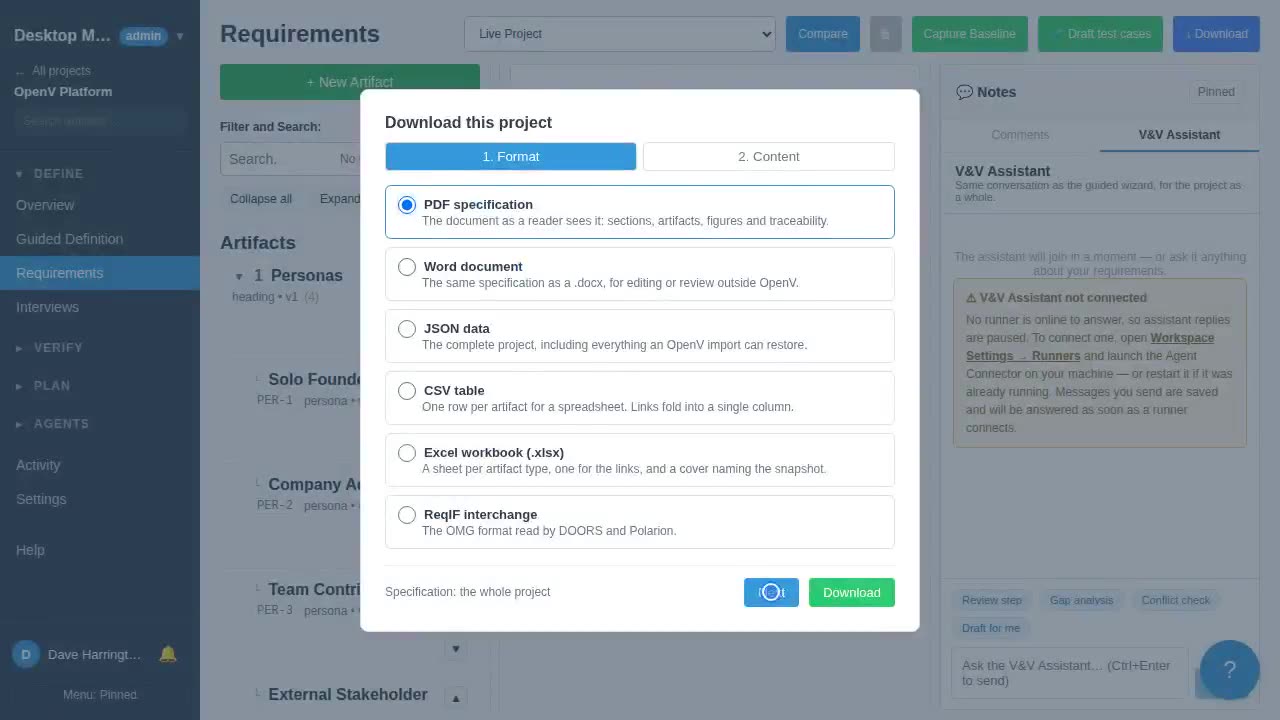
PDF specification
The document as a reader sees it: sections, artifacts, figures and traceability.
Word document
The same specification as a .docx, for editing or review outside OpenV.
JSON data
The complete project, including everything an OpenV import can restore.
CSV table
One row per artifact for a spreadsheet.
Excel workbook (.xlsx)
A sheet per artifact type, one for the links, and a cover naming the snapshot.
ReqIF interchange
The OMG format read by DOORS and Polarion.

Import reads JSON and ReqIF. Every download can snapshot a baseline instead of the live project, and the archive download carries your attachments with it.

Pricing

Free while in alpha, free forever to self-host, and a clear path when your team grows.

Workspaces created during the alpha keep every tier’s features, free, with no member limits — that does not change when tiers turn on. Workspaces created after that are on the tiers below. Export never depends on a plan.

Hosted by us

Single User

Free

The whole product for one person, free. Bring your own AI.

  • Requirements, V&V, traceability and interviews: the full product for one person.
  • Agents run on your own AI subscription (Claude Code, Codex or Gemini) via the Agent Connector on your machine, or a leased cloud runner within the free limits.
  • Personal workspace, plus one shared workspace with one other person.
  • Export everything, always.
Create free account

Business Lite

Coming soon

For one person who wants agents working while the laptop is closed.

  • Everything in Single User.
  • Higher cloud runner limits: 4 GB memory, 2 CPUs, 120-minute lease reclaimed after 20 idle minutes.
  • Attach figures up to 512 MB, so a CAD assembly goes on the requirement it belongs to.
  • Agents on your own API keys instead of a signed-in CLI.
  • Always-on agents: a hosted runner that keeps cron and event automations running unattended.
Tell us you want this

Business

Coming soon

For companies working on the same products together.

  • Everything in Business Lite.
  • Cloud runners again: 8 GB memory, 4 CPUs, a 4-hour lease reclaimed after 30 idle minutes.
  • Attach figures up to 1 GB.
  • Shared company workspaces.
  • Teams, per-project access and the reviewer role.
  • Workspace AI budget and usage reporting.
  • Monthly stable release channel, turned on at a time you choose.
Tell us you want this

Enterprise

Coming soon

For organisations that need it on their terms.

  • Everything in Business.
  • Run on your own servers with our support.
  • SSO/OIDC and directory setup.
  • Custom integrations with your PLM, ALM, ticketing or CI.
  • Support SLA and priority fixes.
Tell us you want this

What free means on the hosted service today

  • One shared workspace you create, with one other person; leased cloud runners for 300 minutes a month.
  • Hosted runner: 2 GB memory, 1 CPU.
  • Cloud runner lease: 60 minutes, reclaimed after 15 idle minutes.
  • Largest figure you can attach: 128 MB.
  • Cloud runners come from a shared pool, so at busy times you may wait for one.
  • Hosted runners cannot reach code repositories. Run the Agent Connector on your own machine for that.
  • Agent runs use your own AI subscription (Claude Code, Codex or Gemini) or your workspace’s own API keys. OpenV does not resell AI.

Business Lite will raise those to:

  • Leased cloud runners: no monthly cap.
  • Cloud runner: 4 GB memory, 2 CPUs.
  • Cloud runner lease: 120 minutes, reclaimed after 20 idle minutes.
  • Largest figure: 512 MB.

And Business again, to:

  • As many shared workspaces and members as you need; members are what is billed.
  • Cloud runner: 8 GB memory, 4 CPUs.
  • Cloud runner lease: 240 minutes, reclaimed after 30 idle minutes.
  • Largest figure: 1 GB.

Prices are per workspace, monthly or yearly, and shown excluding VAT; VAT is added at checkout where it applies, and a business VAT number is accepted. What is free stays free for the workspaces that have it, and export never depends on a plan.

Other ways to run OpenV

Self-hosted

Free forever

Elastic License 2.0. All features, your hardware, no limits from us.

  • One command: git clone, docker compose up.
  • Your data never leaves your machines.
  • Same agents, runners and export as the hosted service.
  • Hosted-runner limits do not apply.
Self-host guide

Charities and open source

Free forever

Registered charities and open-source projects use the hosted service free, for as long as it exists.

  • Everything in the hosted service.
  • Stays free when tiers launch.
  • Claim it with a GitHub issue: tell us who you are and the workspace name.
Claim free hosting

Open-source projects

Open-source teams host free, and their latest baselines are public for anyone to read.

See the projects

Customer stories

Teams using OpenV, in their own words, as they come in.

Read the stories

White papers

Longer reads on agents in the audit trail, flow-down and leaving DOORS.

Browse the papers

Self-host in one command

Docker is the only prerequisite. The stack brings its own database, migrates itself on boot, and the first account to register becomes the admin.

Read the quick start
$ git clone https://github.com/desktopmachineshop/OpenV.git
$ cd OpenV
$ docker compose up -d

Source-available, and built in the open

OpenV is source-available, licensed under the Elastic License 2.0. Self-hosting is free for anyone, at any scale: read the source, fork it, change it, and run it on your own servers for your own teams with every feature. The one thing you may not do is sell OpenV to others as a hosted or managed service.

  • Self-host free, at any scale, with every feature. No licence key, no phone-home, no seat count.
  • Read, fork and modify the source; keep your changes private or publish them.
  • Paid help is fine: a consultant or integrator can charge to install, customise or support a customer’s own OpenV.
  • Not allowed: offering OpenV, or a substantial part of it, to third parties as a hosted or managed service.

OpenV manages its own requirements in OpenV: the live project holds every requirement the platform is built to, with traceability to the tests that prove it. Contributions are welcome under the Developer Certificate of Origin.